
How to Make a Viral Video
- Sergi Galiano

- 27 minutes ago
- 9 min read
Everyone wants to make a viral video. Most people have no idea what that actually means or why it happens.
They think it's luck. It isn't. I've been inside the analytics for billions of views across almost 20 years and multiple platforms - and viral videos follow patterns. Learnable, repeatable patterns. Once you understand them, you stop chasing virality and start engineering it.
Let's start from the beginning.
What Is a Viral Video?
A viral video is a piece of video content that spreads rapidly and widely across the internet through sharing - from person to person, platform to platform - generating a significantly higher number of views than the creator's content typically receives. The word "viral" comes from the idea of a virus spreading: one person shares it with several others, each of those people shares it with several more, and the reach compounds exponentially rather than growing linearly.
Crucially, a viral video is not just a video with a lot of views. A video can have millions of views because a huge account posted it. That's reach, not virality. A truly viral video spreads because people actively choose to pass it on - because something about it compelled them to share it with someone specific. That distinction matters, because it tells you exactly what you need to build into your content.
What Makes a Video Go Viral?
There is no single formula. But there are consistent factors that show up in viral content over and over again regardless of niche, platform, or format. Here are the main ones.
1. Relatable Content That Gets Shared to Someone Specific
The most powerful sharing trigger is specificity. Not "this is broadly interesting" but "I know exactly who needs to see this." When someone watches a video and immediately thinks of a specific person in their life - a friend, a partner, a parent, a colleague - and sends it directly to them, that is the most valuable form of distribution in social media.
This happens when content captures a feeling, a situation, or an experience so precisely that it feels personally relevant. "This is literally us." "You need to watch this." "I've been saying this for years." Those reactions drive direct shares - which on most platforms are the highest-value signal the algorithm can receive, because they indicate that a real human made an active decision to spread your content.It can also be “I completely understand what I’m watching” despite language barriers. Relatable content can be visual references that are globally understood. This relatability helped my “China’s Very American SUV” video go viral because the opening hook started with the door handles… that looked like guns. I didn’t need to say anything, I just put my hand on the handle in a way that clearly visualized it being a gun, and everybody knows what a gun is. I also said “pew pew pew” as a little extra lol.

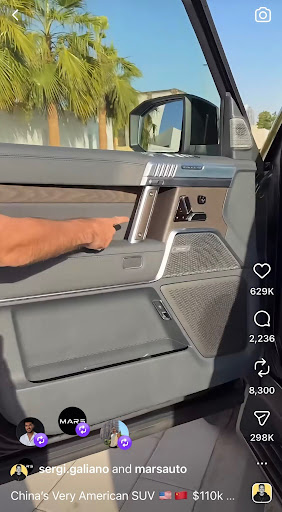

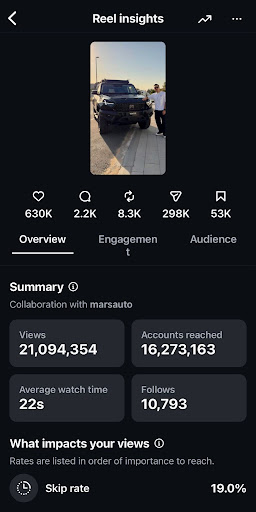
Link to the full video is here btw: https://www.instagram.com/reel/DTN5jnqEptI/?utm_source=ig_web_copy_link&igsh=MzRlODBiNWFlZA==
Relatable content doesn't mean generic content. It actually means the opposite. The more specific and precise you are about a feeling or a situation, the more people feel personally seen by it. Broad content gets passive likes. Specific content gets sent to someone's best friend at 11pm.
2. High Emotion Content
Strong emotional responses override the scroll reflex. When something makes you laugh out loud, gasp, tear up, or feel genuine disbelief - your finger stops. That involuntary pause is what every algorithm is trying to create more of, and content that reliably produces it gets pushed hard.
The emotions that drive the most sharing are: laughter, disbelief, awe, inspiration, and anger. Not mild versions of these - strong versions. A video that makes you chuckle gets a like. A video that makes you actually laugh out loud gets sent to three people. A video that makes your jaw drop gets shared on your story. The intensity of the emotional response is directly correlated to the likelihood of sharing.
This is why "try not to laugh" videos, shocking reveals, and deeply moving moments consistently go viral across every platform and every year. The emotion is the mechanism. The content is just the vehicle.
3. Breaking News and New Information
People share things that make them feel informed. When someone learns something genuinely new - a fact they didn't know, a story breaking in real time, a perspective that reframes something they thought they understood - they want to pass that feeling on. Sharing new information is a social act. It's how people signal to their network that they're plugged in, curious, and worth following.
Breaking news is the most extreme version of this. When something significant happens and you're one of the first to cover it clearly and accessibly, the algorithm doesn't even need to push it - people do the distribution themselves because being early to share news feels valuable.
But this isn't limited to current events. A surprising statistic, a counterintuitive insight, an industry secret most people don't know - all of these carry the "new information" trigger. In almost 20 years of making content, some of the most reliably viral formats I've seen are the ones that open with "most people don't know this" and then actually deliver on that promise.Going back to that “China’s Very American SUV” video, the “new information” that China was now selling a high-quality “American” SUV made the content worth sharing - whether it was as a joke or the sender thinking it was cool. In the end it was new information.
4. The Shareable Moment
Every truly viral video has at least one moment - sometimes one sentence, sometimes one visual, sometimes one statistic - where the viewer thinks: I need to send this to someone. Not "this is interesting." Specifically: who in my life needs to see this exact thing right now.
When I'm reviewing content before it goes out, I ask one question: what is the moment in this video that someone will screenshot or forward? If I can't identify it, the video isn't ready. Build that moment deliberately. It doesn't happen by accident in the videos that consistently go viral - it's engineered in.
I recently uploaded a video of the Nio ES9 - a Chinese luxury SUV with 1 very unique feature: you can control the tint of your windows with unbelievable customization. You can literally have the entire window tinted with just 1 strip being transparent - I made the joke that it’s great for spying. From the moment I saw this feature in person I knew the video was going to get viral views because it was such a unique feature that people would absolutely share it. It combined the “relatability” element because it was a car window (something most of us are used to), it offered new information because it was a window feature that most people in the world didn’t know existed. It triggered the emotion of surprise because windows aren’t supposed to do that. And lastly, it was a very easy to understand video. All those factors together make it a feature worth sharing. My next job of course was to get people to continue watching, but with a hook that strong I knew I was already working at a huge advantage.

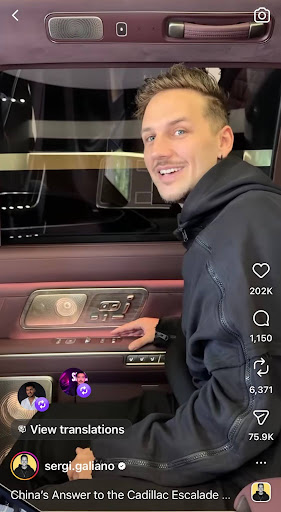

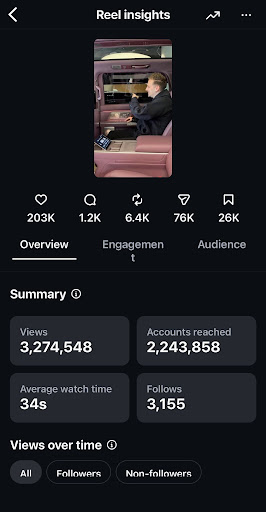
Full reel here:https://www.instagram.com/reel/DYztJMfsnCD/?utm_source=ig_web_copy_link&igsh=MzRlODBiNWFlZA==
How Each Platform Decides What's Worth Distributing
All four major platforms - Instagram, TikTok, YouTube, and Facebook - share one core goal: keep users on the platform as long as possible. To do that they need to figure out which content is worth showing to more people. But the way each platform does this, and what it specifically rewards, is different. Understanding those differences is the difference between posting the same video everywhere and actually optimising for each platform.
Instagram's algorithm distributes content in waves. When you post a Reel, Instagram shows it to a small test group first - typically a portion of your existing followers. It watches what they do. Do they watch to the end? Do they rewatch? Do they share it to their story or send it to a friend via DM?
Based on those signals, Instagram decides whether to push the content to a wider audience - first to more of your followers, then potentially to non-followers via the Explore page and Reels feed. The key metrics Instagram weights most heavily are watch time and shares. A Reel that gets sent to a lot of DMs is a very strong signal that the content is worth distributing further.
The first three seconds are critical on Instagram because the feed is fast and the competition for attention is intense. If your opening doesn't stop the scroll immediately, the retention drop-off shows up in the algorithm's test data and distribution slows. Hook first. Everything else after.
TikTok
TikTok has the most aggressive content testing algorithm of any platform. It shows your video to a very small initial group - sometimes just a few hundred people - and watches the retention data in near real time. If those first viewers watch to the end and rewatch, TikTok expands distribution to a larger group. If that group responds the same way, it expands again. This is why videos on TikTok can go from zero to millions of views in 24 hours in a way that other platforms don't replicate as quickly.
The most important metric on TikTok is completion rate - the percentage of viewers who watch your video all the way to the end. A short video with a 90% completion rate will be pushed far harder than a longer video with a 40% completion rate. This is why shorter, tightly edited content tends to perform better on TikTok - not because TikTok prefers short videos, but because shorter videos are easier to watch to completion.
TikTok also heavily weights rewatch rate. If someone watches your video twice, that is a very strong positive signal. Build your content so that the ending rewards rewatching - a punchline that lands better the second time, a detail that becomes more interesting once you know how the video ends, a payoff that makes you want to go back.
YouTube
YouTube is the most watch-time focused platform of all four. It is explicitly trying to maximise the total amount of time users spend on the platform, which means it rewards content that keeps people watching for as long as possible - not just within your video, but across multiple videos in a session.
The two metrics that drive YouTube distribution more than anything else are click-through rate (CTR) and average view duration. CTR is how many people click your video when it appears in their feed or search results - which means your thumbnail and title are make-or-break on YouTube in a way they aren't on other platforms. Average view duration tells YouTube whether you delivered on the promise your thumbnail and title made.
YouTube also has a powerful search component that the other platforms largely don't. Optimizing your title, description, and tags for the specific words someone would search to find your content gives YouTube videos a longevity that Instagram Reels and TikToks don't have. A well-optimised YouTube video can drive views for years. A well-optimised TikTok or Reel drives views for days or weeks.
Facebook has the most powerful organic distribution mechanic of any platform - and it's one that most creators completely ignore. When someone shares your video on Facebook, it permanently appears on their profile wall. Their friends see it. Those friends can share it on their walls. And those shares are also permanent.
Compare that to every other platform: an Instagram story share disappears after 24 hours, a TikTok repost lives in a tab most people never open, a WhatsApp share gets buried in someone's DMs. On Facebook, every share is a permanent distribution point that keeps sending you views days, weeks, and sometimes months after you originally posted. This compounding share mechanic is why Facebook consistently outperforms every other platform for organic reach on content that genuinely travels.
Facebook's algorithm also specifically weights what it calls "meaningful interactions" - replies to comments, back-and-forth conversations in threads, content that generates real discussion rather than passive likes. Content that triggers an opinion, starts a debate, or makes people want to respond to each other in the comments gets amplified significantly. This is a mechanic no other platform replicates to the same degree.
One practical note on Facebook that most people don't know: always upload your video natively to Facebook rather than cross-posting from Instagram. Facebook's algorithm deprioritises content that originates from a competitor platform. Same video, uploaded directly to Facebook versus shared from Instagram, can produce dramatically different reach - and meaningfully different monetisation payouts if your page is in Facebook's Partner Monetisation Programme.
So How Do You Actually Make a Viral Video?
You build in the triggers. You optimize for the platform. And you start with the hook.
Before anything else - before you think about the middle of the video, before you think about the ending, before you worry about production quality - ask yourself: does the first two to three seconds of this video give someone an immediate and specific reason to keep watching? If the answer is no, the algorithm will find that out in the first test batch and distribution will stop before it starts.
Then ask yourself: what is the moment in this video that someone will send to a specific person? Build that moment in deliberately. It is the engine of organic distribution on every platform.
Then optimize for where you're posting. Tight completion rate for TikTok. Strong thumbnail and title for YouTube. Shareable, opinion-triggering content for Facebook. DM-worthy moments for Instagram.
Virality is not luck. It's a set of decisions made before you press record, refined in the edit, and matched to the platform you're posting on. The more deliberately you make those decisions, the more consistently the results follow.
Let's get more views.
Remember, you can sign up for our free newsletter to stay up-to-date with my blog posts, or if you want to take it a step further and level up your game you can start with our $100 CRASH COURSE - which includes 8 masterclass style videos, access to our members-only section of our Discord community along with a social media toolkit bundle and our “golden rules” sheet (rules we apply to every single video that we post). Let’s get more views!
-Sergi Galiano

Comments